

The End of Future-Proofing and Why Maturity Is Now a Mirage
An update of an article first posted on LinkedIn.
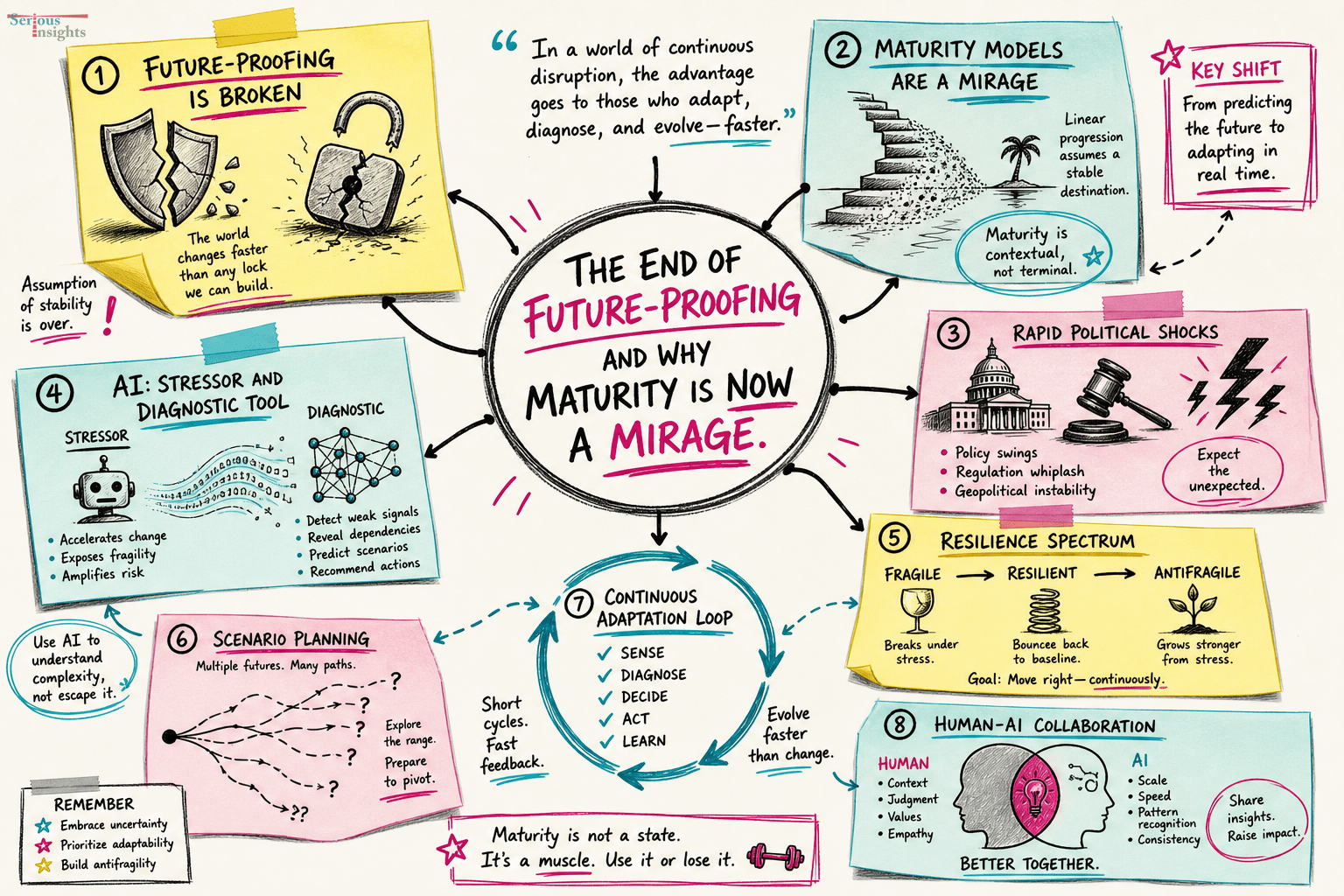
The idea of future-proofing has expired. Maturity, as we’ve known it, is a mirage. What matters now is adaptability at speed—learning as a core competency, resilience as a design principle, and policies, practices, spaces, and technologies that rapidly realign with new realities, and people who embrace change rather than fear it.
As Nassim Nicholas Taleb argued in Antifragile, the goal isn’t to resist or avoid shocks, but to benefit from them. We’re entering a phase where fragility, resilience, and antifragility form a spectrum—and clinging to the old language of future-proofing keeps us at the fragile end.
Key Takeaways
- Future-proofing has become a false promise. Organizations cannot engineer immunity from change. They need systems, policies, teams, and technologies designed to realign quickly as conditions shift.
- Maturity models are giving way to adaptive readiness. Static models that imply arrival or completion break down in fast-moving environments like AI. The better measure is how quickly an organization senses, learns, responds, and improves.
- AI is both the disruption and the adaptation engine. AI accelerates technical and organizational change, but it can also help diagnose readiness, surface resistance, model scenarios, and stress-test responses.
- Resilience is necessary, but antifragility is the higher goal. Organizations should not only absorb shocks and recover from them; they should learn to use volatility, regulation, market change, and technology shifts to become stronger.
- Scenario planning beats prediction. The goal is not to forecast a single future, but to build the capacity to act deliberately across multiple plausible futures, with faster feedback loops and more flexible architectures.
Table of Contents
The Comfortable Lie of Future-proofing
For decades, “future-proofing” has been one of the most overused and least examined phrases in the strategy playbook. Vendors promise it, consultants sell it, executives demand it. The idea suggests that, with sufficient foresight, budget, and clever design, we can create systems and organizations that are immune to the turbulence of change.
In 2025, that claim has collapsed under the weight of reality. The rise of generative AI and the accelerating pace of political and regulatory change, most recently underscored by executive orders from President Donald Trump that have altered the operating environment overnight, show just how hollow the phrase “future-proofing” has become. Taleb would call these moments “Black Swans,” unpredictable, rare, high-impact events that expose the folly of pretending stability can be engineered. Unfortunately, black swans are becoming all too common.
Change Is No Longer a Variable—It’s the Constant
Future-proofing was a marketing term that worked well when technological progress felt incremental (I think that “felt” is the right word, as technological progress was never truly incremental). Organizations designed systems with five-year upgrade horizons, replacing components as needed, and kept the business running with minimal disruption. (In the 1980s and 90s, I helped manage multiple Material Requirements Planning (MRP) implementations and introduced expert systems. Those did not feel incremental.)
Now, foundational AI models evolve monthly, not annually. A capability considered cutting-edge in February may be obsolete by summer, not because it has failed, but because a new model has emerged that has rewritten the efficiency equation. OpenAI’s GPT-3, considered state-of-the-art in early 2023, was quickly surpassed by GPT-4 within months, resulting in significant shifts in AI-driven applications.
The changes have not stopped coming. OpenAI recently released ChatGPT-5, which opened new possibilities for interaction, improved quality expectations, but also challenged “relationships” consumers and programmers had built with ChatGPT 4o, leading to massive feedback about the way the model responded, not unlike the way iPhone owners often react to Apple’s yearly updates to user experiences. The half-life of technological advantage has dropped from years to quarters to weeks.
Political volatility has joined the mix. Executive orders on trade, data sovereignty, and federal AI policy are issued without warning, instantly shifting compliance requirements and market conditions. In this environment, the idea of building something that will “withstand” change has less to do with thoughtful planning and more to do with wishful thinking. Antifragile organizations don’t just withstand these shocks; they exploit them by leaning into the wave, by transforming turbulence into catalysts for innovation.
This shift isn’t only abstract. It plays out directly in how organizations structure change. Where turbulence once demanded careful orchestration by managers, AI has started to rewire the mechanics of adaptation itself. Companies like Netflix have demonstrated resilience by continuously adapting their content delivery networks to handle varying loads and regional regulations.
Traditional change management relied on centralized oversight, with managers orchestrating transitions through programs, communication plans, and staged adoption cycles. That model assumed both pace and predictability. AI undermines that monopoly. It doesn’t manage change in the old sense; it distributes adaptation across the system. Algorithms surface resistance patterns in real-time, nudge individuals toward new behaviors, and continually update organizational readiness assessments.
Adaptation is not a program to roll out but an emergent property of the system itself. This is why maturity models collapse under AI: if technology is dynamically shaping how individuals and teams adapt, there is no linear progression to chart. Adaptation is perpetual and decentralized, a loop of sensing and responding that never stabilizes.
The implication is profound: AI doesn’t just accelerate technical cycles; it accelerates organizational ones. The response loop itself becomes compressed, with adaptation embedded into daily workflows rather than staged as episodic programs.
AI Has Made Predictability an Illusion
Generative AI didn’t just make technology faster; it broke the illusion that the future is a knowable thing. AI systems are not static tools; they are dynamic, probabilistic engines whose behavior and outputs can change with every fine-tune, model swap, or integration.
When AI becomes the core of processes, organizations are no longer future-proofing—they are future-entangling. The technology’s evolution becomes an inseparable component of strategy. A competitive advantage that depends on a particular AI capability may require workflows, a compliance posture, and even product offerings to adapt on a monthly basis. Taleb’s frame pushes further: this entanglement isn’t just risk; it can be the very mechanism by which organizations sharpen themselves: by employing volatility as a training tool.
This all implies that organizations’ response cycles will also accelerate as AI acts as mediator and manager of the change process.
Future-Proofing’s Cousin: The Myth of Maturity
If “future-proofing” is the promise of stability, “maturity” is the declaration of arrival. Maturity models, whether in IT governance, cybersecurity, or knowledge management, imply a linear progression toward a stable, optimal state, or worse, one that sets expectations for accelerated performance and improved innovation. They reassure leaders that if they climb the rungs, they will reach the top, plant a flag, and enjoy the view.
However, the only thing that remains constant at the top of a maturity model is the diagram itself. In reality, the moment of arrival is the moment organizations start to realize that being “mature” isn’t enough, and that the goal line has changed, for them, and if they are honest, for the maturity model.
In a rapidly evolving domain like AI, maturity proves a false final step. I would argue that it is not even a temporary plateau but a concept that we should abandon. Models that suggest progress are best developed for a particular organization and should be adapted regularly as the environment changes, be that weekly, monthly, or less frequently, depending on the market.
Maturity always suffered from being overly broad, too focused on an enterprise ideal rather than accepting the unevenness of adoption and deployment across complex organizations. How teams and functions articulate success defined the path toward it, resulting in coexisting levels of “maturity” that prove impossible to reconcile.
When Maturity Means Obsolescence
In technology, a model that doesn’t change is usually not a sign of perfection; it’s a sign of irrelevance. A “mature” mainframe application in 2025 may be fully optimized for its environment, but that environment may be economically unsustainable, insecure, or disconnected from the rest of the enterprise.
The same is true for processes. A “mature” waterfall development practice might hit all its stage-gate metrics, but it will still lose out to more adaptive, AI-augmented agile teams. Maturity in the traditional sense often signals a lack of adaptation, rather than a mastery of it. In antifragile terms, maturity is fragility disguised as achievement.
Resilience Over Proof
If future-proofing is dead, what replaces it? Not a new slogan, but a change in mindset. We should design for resilience, the ability to absorb disruption and recover quickly, not for immunity from change.
Resilience acknowledges that technologies, regulations, and customer expectations are constantly evolving. It prioritizes modularity, interoperability, and rapid experimentation. It invests in teams that can learn new tools quickly and who treat change as a recurring part of the job, not as an exception. Even if that change results in redefining or eliminating existing roles. However, resilience alone is not the ultimate goal. The antifragile organization goes further: it actively seeks stressors to test itself, learning faster and gaining strength precisely through volatility.
This is not simply a theory. The very technologies driving volatility are also offering the tools to measure and rehearse resilience.
Unlike many past disruptions, the disrupter is usually independent of diagnosis or solution. In the case of AI, it is the stressor, but also the diagnostic tool and perhaps even a remedy.
AI should be considered a resilience multiplier: organizations can use it not just to absorb disruption but to sense it earlier and rehearse responses. AI can be used to analyze organizational readiness and stress-test transformations. Unlike many past disruptions, the disrupter is usually independent of diagnosis or solution. In the case of AI, it is both a stressor and a diagnostic tool, and perhaps even a remedy.
Continuous Adaptation as the New Maturity
If there is one area where some level of maturity remains applicable, it is in an organization’s capacity to adapt. Rather than concentrate on our designs and architectures, our implementations and applications, we should evaluate our capability for continuous learning, adaptation, internal conflict resolution, and other attributes that underpin organizational resilience.
Organizations should stop measuring maturity as a static state; instead, they should focus on continuous improvement. Rather than measuring design and architecture by their goals, they should measure reaction times, the quality of choices, and adaptability in response to change, and ultimately, by their ability to improve under stress.
A maturity model worth its name in 2025 would not end in “Optimizing” or “Transformational” stages. It would be a loop, not a ladder, a cycle of sensing, responding, and evolving. The measure of success would be how quickly an organization can detect signals, pivot operations, and reconfigure technology to fit the moment. This is Taleb’s logic rendered in organizational terms: survival doesn’t come from avoiding stress, but from metabolizing it into advantage.
Demis Hassabis, CEO of Google’s DeepMind, recently stated that the critical skill of the future was “learning how to learn,” which implies not only a new emphasis on roles within enterprises but a reconsideration of education to prepare people for fast-paced, change-driven careers.
Political Shocks as Proof Points
Recent executive orders issued by U.S. President Donald Trump on AI security, domestic sourcing of advanced components, and restricting foreign cloud usage serve as reminders that political change can be a significant force multiplier for technology disruption.
Future-proofing often assumes that change occurs via new technology; however, many of the most destabilizing changes are political and regulatory, because they can render technology investments non-compliant or economically infeasible overnight. Social factors also play a role as consumers assert the attention economy, which not only passes judgment on the effectiveness of technology, but on its likability.
If AI training data suddenly falls under a restricted category because of a political decision, it doesn’t matter how robust an architecture is; it requires rebuilding, retraining, or abandoning it.
If AI training data suddenly falls under a restricted category because of a political decision, it doesn’t matter how robust an architecture is; it requires rebuilding, retraining, or abandoning it. Rather than future-proofing, it creates an environment for ongoing triage. For the antifragile, it’s also an opportunity: the forced redesign that may open new strategic pathways.
Scenario Planning Beats Predictions
In this climate, the most useful planning discipline is not prediction; it’s scenario thinking. Scenario planning acknowledges uncertainty and prepares for multiple possible futures, without committing to any single outcome.
AI tools can now model those scenarios more quickly and with a greater number of variables than ever before. AI again assumes dual roles: that of a driver of uncertainty and an amplifier of the ability to identify resistance and test interventions. Antifragile organizations thrive here: they treat scenarios as exercises to stretch thinking, stress-test assumptions, and build optionality into every decision.
The effectiveness of scenarios will remain not with the number of alternatives available to consider, but in an organization’s capacity to deliberate deliberately.
AI-driven scenario planning will be able to model uncertainties across narratives at scale. That may, however, lead to too many options and insufficient reflection, even if that reflection is necessarily brief, given the accelerated pace of change. Organizations, however, still need to be purposeful in choosing their direction, rather than opportunistic; otherwise, response mechanisms may lead to markets where competition is solely about speed, with little else.
The effectiveness of scenarios will remain not with the number of alternatives available to consider, but in an organization’s capacity to deliberate deliberately.
The Language We Need Now
The problem with “future-proofing” and “maturity” is not just that they’re inaccurate; it’s that they frame the wrong goals. They lead leaders to believe they can plan for permanence in an impermanent world.
We need language that sets expectations for constant evolution:
- Adaptive readiness instead of maturity.
- Operational resilience instead of future-proofing.
- Continuous reinvention instead of stability.
Rather than selling the fantasy of control, these phrases describe the discipline of navigating change effectively. And for those willing to push further, the art of benefiting from disorder.
We also need to reconsider the language we use to describe the “work” that humans do. AI redefines human adaptability. Executing change through traditional change management has reached an impasse.
AI and humans will constantly switch places between asking good questions and suggesting and selecting solutions. That back-and-forth will likely lead to tensions that fuel anti-fragile responses.
Now, and going forward, people will assess AI signals, make judgment calls, and reconfigure work in ways AI cannot prescribe. AI and humans will constantly switch places between asking good questions and suggesting and selecting solutions. That back-and-forth will likely lead to tensions that fuel anti-fragile responses.
The Opportunity Hidden in Uncertainty
Abandoning future-proofing doesn’t mean surrendering to chaos. It means aligning strategies with operational environments. Discarding the myth of maturity means building organizations that expect the unexpected and view every change as an opportunity to differentiate, to practice agility and nimbleness, so they don’t get lost in false narratives that present “best practices” as a fait accompli.
In a world where AI reshapes industries and political shifts can reorder the rules overnight, the winners won’t be those who build the most “future-proof” systems. They’ll be the ones who build the fastest feedback loops, the most flexible architectures, the most adaptable teams—the ones with the courage to let volatility make them stronger.
For more serious insights on management, click here.
Did you find this post about Future-Proofing useful? If so, please like, share or comment. Thank you!
The cover image is AI-generated from the author’s prompt.
Leave a Reply