

CES 2025 seemed a little flat. As I forecasted last year, AI would be everywhere, but it would become increasingly difficult to demonstrate as physical objects incorporating AI don’t look that different from those not using AI. Generative AI did find its way to the show floor in the form of virtual and physical talking heads along with education demonstrations, it was dwarfed by machine learning—the autonomic form of AI that checks on sensors, maps patterns, adjusts lighting and improves image quality, and many other tasks that take place in brains but do not require intelligence or knowledge in the same way we consider generative AI responses.
The initials “AI” were often joined by other words to expand their promise or modify their meaning. Samsung touted “AI for All,” while key competitor LG’s booth was emblazoned with “Affectionate Intelligence,” a phrase that reads a little creepy to me. Of course, like most computer manufacturers, the major AI companies did not have a presence of their own on the floor, preferring to appear through proxies like the aforementioned talking heads and holograms.
Despite the lack of groundbreaking new technologies, this more incremental CES delivered updated AI chips, a range of augmented reality glasses, and leaning toward robotics in terms of devices and operating environments, like the Nvidia Cosmos model that may be the foundation of next-generation robotics.

Nvidia Cosmos AI model
Nvidia may have just unveiled the AI platform that could define innovation at CES for years to come. Enter Cosmos, described by Nvidia CEO Jensen Huang as “the world’s first world foundation model.” This groundbreaking platform aims to address a critical challenge: the immense need for training data to make empower robots and other autonomous systems.
Cosmos leverages AI to simulate the data robots require, transforming digital models of roads, factories, homes, and other environments into dynamic, high-fidelity simulations. Innovators can now test, train, and refine their robotic and autonomous systems in these virtual spaces, enabling faster iteration and deployment.
Huang emphasized that Cosmos’ capabilities will operate most efficiently on Nvidia hardware, a clear nod to the company’s powerful GPUs. Yet perhaps the most intriguing announcement was Nvidia’s commitment to open-sourcing Cosmos. By making the platform’s code available on GitHub, Nvidia invites the global developer community to collaborate and push the boundaries of what this technology can achieve.
The implications of Cosmos were evident in other announcements at CES 2025. Nvidia showcased partnerships where Cosmos is already driving progress, from next-generation factory robots capable of nuanced decision-making to autonomous vehicles simulating millions of miles of diverse road conditions. These practical applications underscore Cosmos’ potential as a linchpin for AI innovation.
Nvidia’s move reflects a broader trend at CES this year: the democratization of cutting-edge AI. By lowering barriers to entry for developers and fostering an open ecosystem, Cosmos could be the catalyst for transformative advancements in robotics, AI, and automation.
ArchetypeAI’s physical foundation model
With a lot less fanfare than Cosmos, Archetypeai shared their physical world model that will likely be as necessary for connecting sensors and IoT as Cosmos is for robotics. i can easily see developers building solutions that require interactions between the ideas behind these two models.
Other interesting AI models
AIZip‘s micro models also offer an intriguing look into the future, where AI will become smaller, more modular, and more purposeful.
DeciZone combines decision trees with AI to transform processes.
For 3D synthetic data derived from video in support of physical, real-world applications in manufacturing, construction and logistics, with an emphasis on safety applications, take a look at Another Real.
Lenovo’s ThinkBook Plus Gen 6
There were few business-oriented breakthrough laptops at CES 2025. While the Asus Zenbook A14 showed off its Ceraluminum chassis and Qualcomm Snapdragon X processor-driven AI features, it still looked, essentially, like a nice, and at just a little over $1K, affordable notebook computer.
As they like to do, Lenovo showed off a computer that doesn’t look like other computers.

Lenovo’s ThinkBook Plus Gen 6 rewrites the boundaries of laptop innovation with its rollable OLED display. This futuristic design expands from 14 inches to an impressive 16.7 inches, offering users a dynamic workspace at the touch of a button or a simple hand gesture. The display boasts a 120Hz refresh rate, 400 nits of brightness, and 100% DCI-P3 color accuracy, delivering vibrant visuals that will undoubtedly appeal to creatives and professionals alike.
Beneath the surface, the laptop packs Intel’s Core Ultra 7 Series 2 processor, up to 32GB of LPDDR5x RAM, and a 1TB PCIe Gen4 SSD, ensuring top-tier performance for multitasking and resource-heavy applications. Despite its groundbreaking display technology, the ThinkBook Plus Gen 6 remains portable, weighing 3.73 pounds and measuring just under 20mm in thickness.
However, innovation comes at a cost—literally and figuratively. Priced at $3,499, this laptop clearly targets a premium segment, putting it out of reach for many (though as with all of my comments on laptop pricing, discounts will follow).
The rollable display, while impressive, is treated as a separate monitor by Windows, requiring Lenovo’s proprietary software to unlock its full potential, which may lead to some usability friction.
Connectivity is also limited, with just two Thunderbolt 4 USB-C ports and a 3.5mm audio jack, which might frustrate users who rely on more robust port options (one thing CES had aplenty were Thunderbolt 4 hubs, however).
In addition to the ThinkBook Plus Gen 6, Lenovo also showed off the ThinkPad X9 with Lenovo AI Now, which leverages a local Large Language Model (LLM) using Meta’s Llama 3.0 to deliver real-time intelligence to users without risking their data by sending it over the Internet to third-party AI providers. Lenovo AI will also include cross-device knowledge retrieval, document searches and summaries and multilingual support, with German, Spanish and French as the first languages.
The Aura Edition picks up several Intel intelligence features, such as Smart Modes, that optimize device configuration based on the work being done. Smart Share enhances photo sharing between Android™ or iOS devices, while Smart Care monitors device performance and service needs.
For more on Lenovo, click here: https://news.lenovo.com/pressroom/press-releases/lenovo-at-ces-2025-redefining-business-technology-with-bold-innovations-and-ai-powered-solutions/
HP also deserves a mention for the HP OmniStudio X and its elegant, all-in-one design.
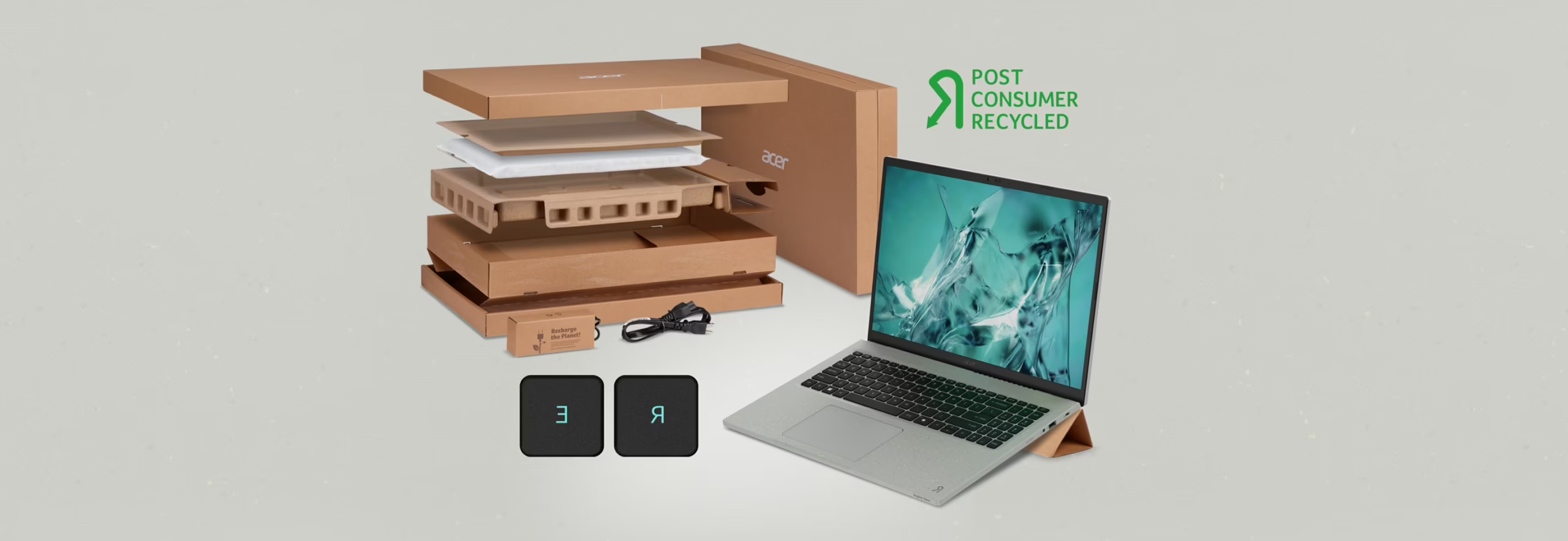
All major PC manufacturers are moving to sustainable materials for packaging and manufacturing, but Acer is leading the way with the Aspire Vero 16, which combines recycled plastic with oyster shells to form its chassis.
Linux AI PC
Nvidia’s Project Digits PC is a Linux-powered desktop designed specifically for AI developers. Priced at $3,000, it is not aimed at the general public. However, it boasts impressive specifications, including an ARM-based Grace CPU equipped with 20 cores (10 Cortex-X925 and 10 Cortex-A725) and 128GB of memory. This enables the development of AI models with up to 200 billion parameters, providing data center-level performance within a single desktop.
AI chips
Most laptops stayed off the floor in suites and restaurants at CES 2025. AMD, Intel, Nvidia and Qualcomm, however, all showed up on the floor with chips to power AI workloads. AMD launched the Ryzen AI Max. Intel touted its Core Ultra 200V, while Qualcomm introduced the Snapdragon X for mid-range laptops.
Flint paper batteries
Batteries are a big deal in mobile electronics. Singapore start-up Flint showed off paper batteries that use cellulose as the medium for ion transfer between the anode and cathode. The easily malleable material can scale to watch battery sizes or be embedded into straps and cases. They take about six weeks to decompose when spent. Read more here: https://www.madebyflint.co.
Aurzen Zip projector
The Aurzen Zip is the smallest 720p projector I have ever encountered. When folded, the $200 Zip is approximately the size of half an iPhone, making it an ideal on-the-go projector. The trifold projector enables wireless mirroring of your phone’s content without the need for a Wi-Fi connection. Two notable features of the Zip are its MagSafe compatibility and its 90-minute battery life. Zip is a Kickstarter project.
A Robot that picks up socks: Roborock Saros Z70
I usually focus these roundups on business technology, but I have to shout out to Roborock for creating a vacuum-mop hybrid that also includes an arm for picking up socks and other small objects. https://us.roborock.com/pages/roborock-saros-z70
Capturing handwritten text with only a pen: Nuwa Pen
The Nuwa Pen is a smart ballpoint pen that digitizes handwritten notes on any paper, seamlessly bridging the gap between traditional writing and digital organization. Equipped with AI, computer vision, and motion sensors, it captures every stroke in real time, transferring notes to the Nuwa+ companion app for easy sharing, searching, and synchronization across devices. Content becomes searchable via an LLM. Covered in previous years. Still waiting to spend quality time!
AR glasses
Wearables, mostly considered a consumer experience, will likely change the way we work by changing the way we see, hear, and even sense. I have always been a fan of augmented reality (AR) over virtual reality (VR), as AR allows for more continuity of experience.. A number of AR glasses launched or offered refinements at CES 2025. Here is a list:
Sightful offers the most work-oriented offer with glasses aimed at creating virtual workspaces that can exist in a virtual blended reality that winks in or out at the tap of a button, getting very close to an experience that switches between AR and VR. I think this is the display technology of the future, creating virtual canvases of displays rather than building ever more complex multi-monitor desk environments.
Executives may want to bring people back to the office, but technology like Sightfuls makes virtual working even more compelling and suggests that while the mixed reality modes may offer sight into the real world, it may also be not only immersive, and perhaps more isolating, than physical monitors. Multiple displays and huge work canvases are not a bad idea for concentration (or maybe they are), but these massive visual environments also limit the argument that bringing people back together in a physical space is better when their virtual interactions may prove more engaging.
Even Realities Even G1 promises selective connectivity in a stylish frame engineered from the ground up to integrate information into the visual experiences. Watch the background video as the Even G1 team shares the origins of the G1 design and technology.
Halliday uses micro projection to provide simple information like date, time, translations, messages, and text via a display module that does not integrate with the lenses. Haliday also claims proactive AI, which I always worry about as I’m not sure I want an AI that is trying to figure me out, but if it works, and its not annoying (which is the key), it could use environmental cues to offer timely assistance and insight. We’ll have to see in practice.
Rokid Glasses deliver an immersive, wired augmented reality experience that can leverage their Android computing module. Equipped with Sony Micro-OLED displays offering 1200p resolution per eye, a 50-degree field of view, and a brightness of up to 600 nits, these glasses provide vibrant visuals suitable for both media consumption and gaming. Integrated directional speakers, noise-canceling microphones, and physical controls enhance usability, while USB-C connectivity supports a variety of devices, including Android smartphones and Windows PCs. Paired with the Rokid Station 2, they expand into a spatial computing platform, enabling portable productivity and entertainment. Rokid offers several models and accessories. The new Rokid AR Joy 2 pricing starts at $548.

XReal showed the One Pro, priced at $600. The glasses feature an external display that can be customized by adjusting the size and position of the screen through the device’s dual 1080p displays. Additionally, a switch allows users to fix the window in space or follow their head’s movements. Notably, the XReal One Pro supports ultrawide screen mirroring on PC, comparable to the Apple Vision Pro and Meta Quest 3.
While the concept of an external display is not novel (Lenovo and other brands offer similar, tethered glasses), the XReal One Pro’s unique feature lies in its ability to dynamically adjust the screen’s size and position. This flexibility enhances the user experience and provides a more immersive viewing environment.
Solos AirGo Smart Glasses With ChatGPT for $299 enable users to pose inquiries and have their texts read aloud. The frames incorporate speakers, which faciliate, voice calls and audio playback. The modular design of the frames, facilitated by SmartHinge (utilizing a USB-C connector port for connection to the lenses), allows for the interchangeability of frames with various lenses, catering to changing preferences or outfit matching. Furthermore, the lenses can be swapped to transition between eyeglasses and sunglasses.
Pins, earbuds and bands
In addition to smart glasses, other CES 2025 wearables included earbuds and bands aimed at augmenting experience in general, capturing what we see or hear throughout the day. Our days become data for post-processing. If we forget something, we can recall it from the treasure trove of data recorded during our wanderings and conversations, as well as our other encounters with the world.
A pin that captures life as you live it. Luci from OpenInterX, unlike last year’s Rabbit R1, seems very focused on mission, avoiding overpromising AI beyond organizing experiences on the Luci Hub. I like that they call it a “temporal computing platform” as a marketing differentiation. It literally captures and replays things that happen in time. Luci currently runs $99 for preorders, promised in Q2 of 2025.
Natura Umana HumanPods demoed their prototype open earbuds that integrate AI, including leading LLMs into all-day listening experiences. Supported by NatureOS, owners will talk to “AI people” about whatever they want to talk about. The AI can also act as agents, connecting to others or taking on tasks. It will be interesting to see if earbuds become the de facto interface to voice-based AI.
If a pin or earbuds aren’t your choice for capturing your life, perhaps a wristband from Bee that can record everything that happens to its wearer during the day. Then, chat about lessons learned, choices or explore new knowledge based on experiences. A pause button keeps it from listening to whatever the owner doesn’t want it to hear. At only $50, which includes the app subscription, Bee may become the AI fad item of 2025.
Another all-day capture device comes from Plaud.ai with its $45 NotePin that can be worn on a wrist, pinned on, attached to a lanyard (or necklace) or clipped on. It requires a press to start recording, but like other offers in this category, it uses AI to organize and recall content from its recordings. Supports multiple speakers in 112 languages.
Virtual people
Also of interest to businesses are virtual people, projections and robots (and robotic heads) that can interact with customers in public situations. Two of those that drove interest on the show floor were the ChatGPT-enabled Perso.ai and the realbotix talking heads.
For more serious insights on hardware and accessories, click here.
Leave a Reply